
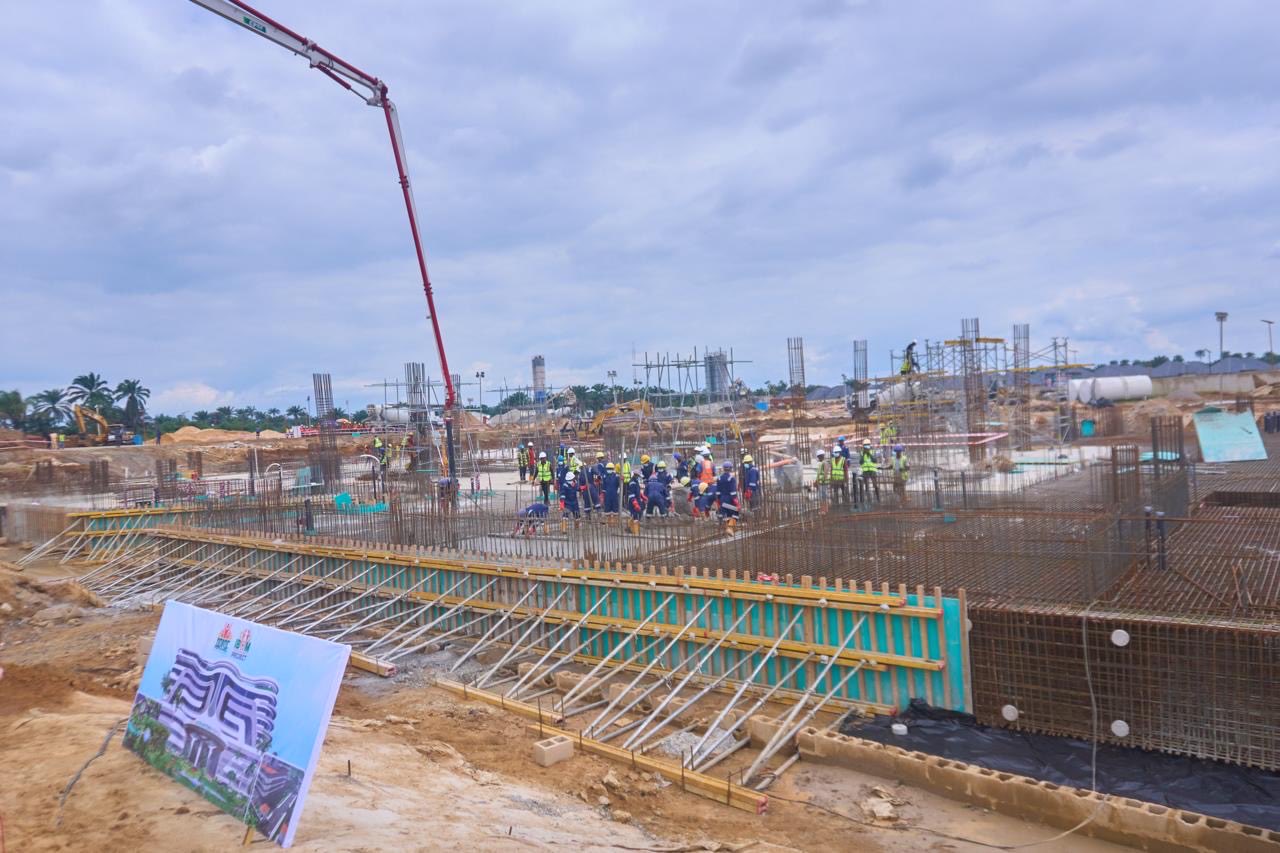
The imposing structure situated on approximately 100 hectares of land along the Uyo-Ikot Ekpene Highway in Akwa Ibom State, South-South Nigeria, is the site of a new investment initiative in healthcare excellence under the state government’s ARISE Agenda.
Birthed by His Excellency Pastor Umo Eno, governor of Akwa Ibom State, the Ibom International Hospital (IIH) and the multifaceted Ibom Medical City form a designated health, life sciences, and medical tourism corridor that will help deliver world-class healthcare services across critical specialties, including oncology, cardiology, cardiovascular surgery, neurology, neurosurgery, trauma care, orthopedics, critical care, and other advanced fields of medicine.
Every year, thousands of wealthy patients travel abroad, mainly to the United States, the United Kingdom, and India, to seek medical treatments not available at home. Data from the Federal Ministry of Health and Social Welfare and the Nigerian Medical Association reveal that Nigerians alone are estimated to spend at least $2 billion annually on foreign hospital visits.
However, today, the IIH, developed by the Akwa Ibom State Government, with Tokiye Integrated Medical Services (TIMS), a premier health systems development and management company as the project coordinating firm, is designed to reverse the prevalence of medical tourism and make locally available the medical services for which many travel abroad at great expense.
“The Ibom International Hospital is a government investment,” said Dr. Teinye Isokariari, the chief executive officer of Tokiye Integrated Medical Services. “The government is investing in something that will bring returns to the people. It is a health sector investment because the idea is to ensure that someday, the state will not have to depend solely on the oil and gas sector or the FAAC allocation to sustain itself.”
The idea of setting up a smart, world-class hospital in Akwa Ibom State is rooted in the vision of Pastor Umo Eno, the governor, in line with the United Nations Sustainable Development Goals (SDGs) 3, which aims to ensure healthy living and well-being for the people. Governor Eno described the project as one of the most ambitious healthcare investments in the state’s history, designed to deliver world-class healthcare services while contributing to economic growth and human capital development.
“Akwa Ibom is rising to a golden era, and we aim to have a healthy, agile, productive workforce to help drive our growth and shared prosperity,” Eno said at the official unveiling of the project in June. “The Ibom Medical City is one of the most audacious projects we are currently executing for the benefit of our people in particular and the nation in general.”
The IIH features a 350-bed, ten-floor healthcare facility, 62 medical specialties, medical residences, pharmaceutical and life sciences facilities, rehabilitation centers, and other healthcare support services. In addition, the hospital will have a 100-unit medical residence for the expert manpower that will staff it, as well as a helipad for emergency airlifts from the Ibom International Airport.
Furthermore, the hospital will be involved in medical research and will encompass an innovation and training hub, an integrated healthcare and specialist care network, digital health wellness and rehabilitation facilities, a solar farm, and other power sources, all while creating employment opportunities.
One commendable aspect of the ongoing project is that the coordinating firm is prioritising local contractors and vendors, including employment and training, to enhance the financial and socioeconomic status of companies, host communities, and the people.
“The idea is that before this project ends, we expect to have about 1,500 Akwa Ibomites who will have worked on this project,” said Dr. Isokariari. “At least 200 to 300 will acquire skills that will provide them with a paradigm shift to a better socioeconomic status.”
With the progress observed on-site, the project aims to demonstrate that Africa can match global standards. Dr. Isokariari stated that the project is not being compared to any other hospital in Africa but is instead being evaluated alongside hospitals in Europe.
“The entire design, from ideation to concept development, is innovative. Many of the systems we are using here have never been implemented before. The equipment has been ordered from Siemens, and all payments have been made.
“When this hospital is completed, it will be managed privately. The idea is that it is viewed as an investment by the government and will operate as an independent hospital.
“The goal is to reverse medical tourism, attracting people from outside the country to Nigeria for medical care because we now have the same facilities and the expertise to manage these conditions locally.”
A delegation of federal government officials, led by Prof. Muhammad Ali Pate, the Coordinating Minister of Health and Social Welfare, attended the unveiling and groundbreaking ceremony and were impressed by what they saw. Pate hailed the project as a landmark investment that will advance Nigeria’s ambition to become a leading destination for quality healthcare in Africa.
With the flagship facility and the broader medical city project officially underway, Akwa Ibom State is now working to transform the narrative of its healthcare sector. When completed by June 2027, as scheduled by the state government, the Ibom Medical City will enhance Akwa Ibom’s reputation as one of Nigeria’s fastest-growing cities.
• Itoro Bassey writes from Uyo