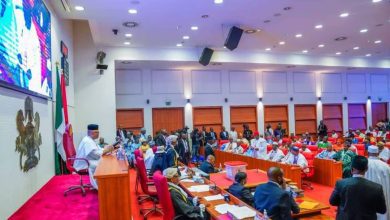
ABUJA: The Senate on Tuesday rescinded its earlier decision on the Electoral Act amendment in which it rejected the mandatory electronic transmission of election results from polling units to the Independent National Electoral Commission’s (INEC) Result Viewing Portal (IREV) after vote counting.
The upper chamber consequently re-amended the Electoral Act to accommodate the electronic transmission of results. However, the provision comes with a caveat that, in the event of internet failure, Form EC8A will serve as the primary means of result collation.
Despite the change, the amendment does not make electronic transmission mandatory. Instead, it allows results to be transmitted electronically while providing an alternative in cases of network failure.
The decision followed a motion moved by the Senate Chief Whip, Tahir Monguno, during an emergency plenary session.
Mr Monguno, who represents Borno North Senatorial District, said the decision to rescind the Senate’s earlier rejection of electronic transmission was informed by the need for the Electoral Act to reflect the wishes of Nigerians.
“This amendment is to bring our laws to make it a replica of the wishes and aspirations of the people. I was the one who moved a motion on the retainment of the previous Electoral Act which is generating controversy,” he said.
During the earlier clause-by-clause consideration of the Electoral Act amendment last Wednesday, Mr Monguno had urged the Senate to retain the provision in Clause 60 of the 2022 Electoral Act, which permits the transmission of election results to collation centres.
However, during Tuesday’s plenary, Mr Monguno made a U-turn, urging the Senate to delete its earlier recommendation due to the controversy that trailed the amendment’s passage.
He said the clause required further legislative review to ensure the conduct of smooth, transparent and credible elections in Nigeria.
“Upon careful examination of the Bill, fresh issues have emerged in respect of Clause 60(3), which requires further legislative consideration in order to ensure the conduct of smooth, transparent, and credible elections in Nigeria.”
The Minority Leader, Abba Moro seconded the motion.
The Senate President, Godswill Akpabio, subsequently put the motion to a voice vote, which was supported by a majority of lawmakers.
With the latest amendment, the Senate has effectively acknowledged that its earlier version of the amendment was passed without a provision for electronic transmission of results.
Since last Thursday, Nigerians have been intensely debating amendments to the Electoral Act passed by the Senate on Wednesday.
Although several provisions of the law were amended, public attention has largely focused on one controversial clause which is the rejection of electronic transmission of election results from polling units to the Independent National Electoral Commission’s (INEC) Result Viewing Portal (IREV).
Public opinion has been largely divided. However, many political parties, politicians and social media users have condemned the amendments and urged lawmakers to reconsider them.
Some politicians, civil society groups and activists have staged protests at the entrance of the National Assembly, demanding the inclusion of mandatory electronic transmission of results in the Electoral Act amendment.
The presidential candidate of the Labour Party in the 2023 election, Peter Obi, led a group of protesters on Monday.
Former Minister of Transportation, Rotimi Amaechi; former Minister of Youth and Sports Development, Simon Dalung; and human rights activist and publisher of Sahara Reporters, Omoyele Sowore, led separate protests on Tuesday.
Before the protests began on Monday, some senators in the minority caucus had told journalists on Thursday that the Electoral Act amendment already accommodated electronic transmission of results.
The lawmakers were led by Abia South Senator, Eyinnaya Abaribe of the All Progressives Grand Alliance (APGA). He said confusion over the provision arose from side conversations during the clause-by-clause consideration of the bill in plenary.
At a book launch on Saturday, Mr Akpabio admitted that lawmakers deliberately removed the requirement for mandatory “real-time” electronic transmission of election results during the clause-by-clause consideration of the Electoral Act amendment.
Mr Akpabio explained that the decision was informed by concerns that enforcing real-time transmission could trigger legal disputes if network failures occur during elections.
Harmonisation committee
Following the Senate’s approval of the amended Electoral Act, Mr Akpabio reconstituted the harmonisation committee to reconcile differences between the Senate’s version of the bill and the version earlier passed by the House of Representatives.
He reappointed Simon Lalong (APC, Plateau South) as chairman of the committee.
Other members are Tahir Monguno (APC, Borno North), Adamu Aleiro (APC Kebbi Central) and Adeniyi Adegbonmire (APC, Ondo Central).
Others are Orji Kalu (APC, Abia South) Abba Moro (PDP, Benue), Asuquo Ekpeyong (APC, Cross-River) Aminu Abbas (PDP, Adamawa), Tokunbo Abiru (APC, Lagos), Isah Jibrin (APC, Kogi), Ipalibo Banigo (PDP, Rivers) and Peter Nwebonyi (APC, Ebonyi).
— PREMIUM TIMES