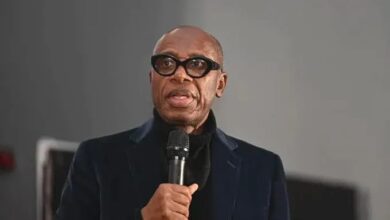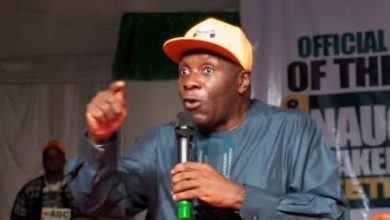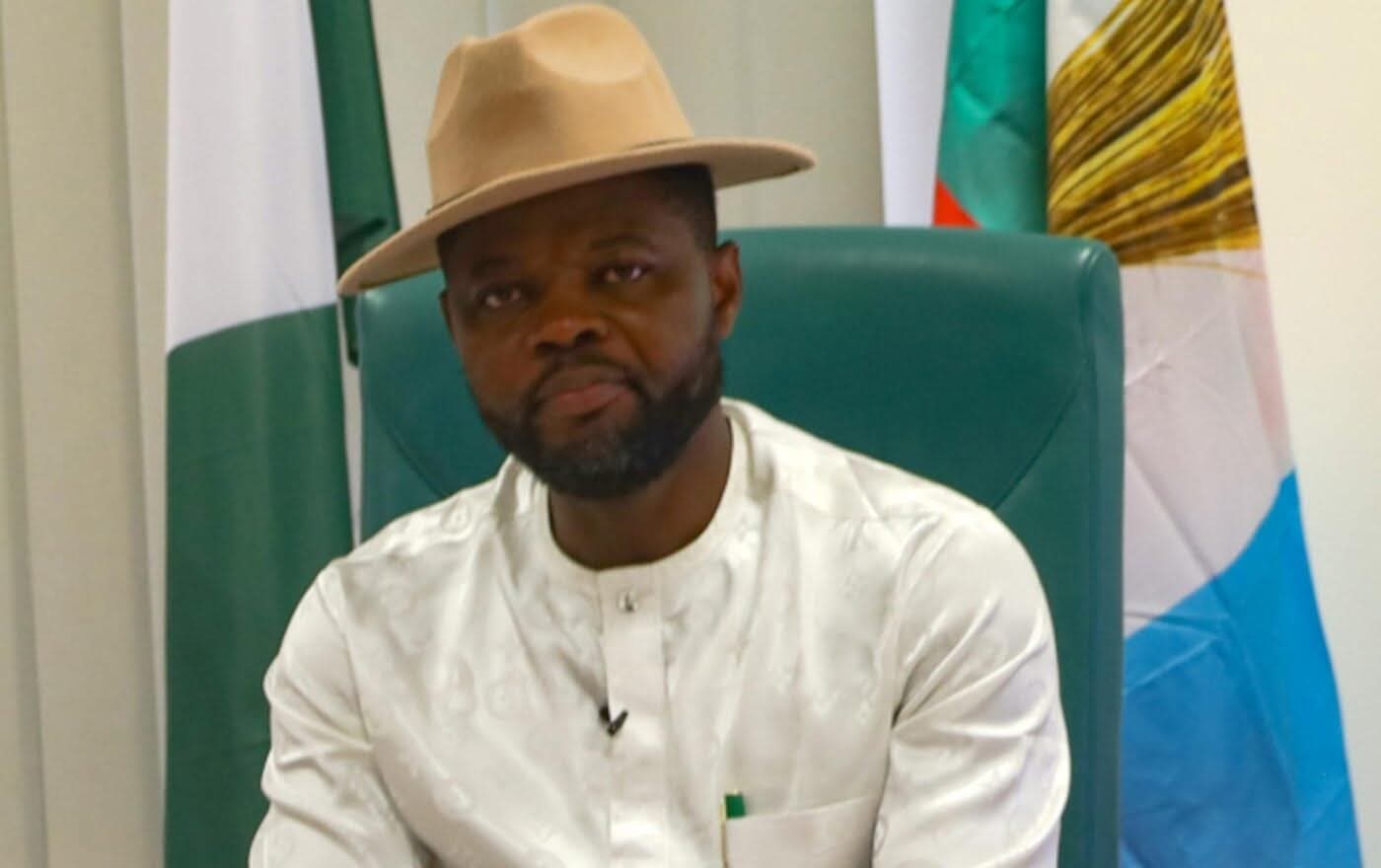
Clement Jimbo is a first-term lawmaker representing Abak/Etim Ekpo/Ika federal constituency of Akwa Ibom under the All Progressives Congress (APC) in the house of representatives.
In this interview with TheCable’s SAMUEL AKPAN, Jimbo says Peter Obi, presidential candidate of the Labour Party (LP) in 2023, will lose his polling unit in the 2027 elections.
The legislator downplays the strength of the opposition coalition rallying around the African Democratic Congress (ADC), defends the house of representatives’ ratification of the Rivers emergency rule, and expresses optimism that the 10th assembly will complete the constitution amendment process.
The lawmaker also speaks on women’s political participation, the performance of Umo Eno, governor of Akwa Ibom, and his plans to seek re-election in 2027. Excerpts:
Many resolutions of the house are not implemented by the executive. What can the parliament do to change this?
Jimbo: Our job primarily is to make laws, and the executive’s responsibility is to implement the laws we make. Part of those laws are resolutions, motions, and petitions we lay before the parliament.
Yes, you rightly mentioned that it is not all our resolutions that are implemented by the executive. Sometimes, it is due to priorities on the part of the executive, but certainly, it is something that will eventually be implemented. I will not say any of my motions have fallen into that classification.
In June 2023, when I was inaugurated, I moved my first motion, calling the attention of the federal government to a dilapidated bridge in Abak LGA. That motion, which was the resolution of the house, received intervention by the federal government, and NDDC had long been mobilised to the site, and work is ongoing.
Equally, in 2024, when I observed that the executive failed to transmit the budget to the national assembly on time, as it is enshrined in the Fiscal Responsibility Act 2007, I called the attention of the federal government to it, and the executive heeded and made the 2024 budget available. Maybe there are other motions of my colleagues, especially when it has to do with establishment bills, which are a product of the availability of funds.
Oftentimes, we see lawmakers re-present motions already presented a few weeks back. Is the committee on rules and business failing in its duties?
Jimbo: No, I wouldn’t say so. Sometimes, there are similarities in motions. It is the responsibility of the committee on rules and business to probe the two bills and determine the similarities.
That is why each time a member raises an observation that a particular motion had already been moved and is being considered in the house, the presiding officer will ask the committee on rules and business to harmonise the two bills. So, it is not a big deal.
In fact, for more than one lawmaker to raise an issue on a particular subject matter shows its importance, meaning it cuts across different constituencies, and should be given credence.
As an insider, do you think the current assembly will conclude the constitution review process?
Jimbo: We have done a bit in the constitutional review. Mr President and the governors’ forum have agreed that Nigeria is due for state policing. Nigerians have equally agreed that, indeed, we need state policing. There are numerous advantages for us to have a state police, so the bill will pass through.
The local government financial autonomy, of course, is already scaling through. Local government chairpersons are seeing increased allocations. If you go to the three LGAs I superintend, you will see projects handled by the local government chairmen. Initially, it wasn’t so. They are handling road construction and buildings. The governors are equally aware that the people are looking at them and are pulling their hands from the allocations that do not belong to them.
Based on available statistics, Nigeria ranks almost the lowest among the committee of nations with women’s participation in politics and of course, we have also looked at all the different cultural background that leads to that. We deemed it necessary to see to it that it is remedied.
Personally, I will support the bill. But I also want to appeal to the women to interface more with the lawmakers who will vote on that day. Instead of doing a lot of media optics, they should get the details of all the lawmakers in the house and in the senate, interact with them, and get their buy-in. If you don’t convince a lawmaker to see why he needs to vote in favour of this bill, he may decide to vote otherwise or may be unwilling to participate.
When do you think the voting on the constitution amendment bills will take place?
Jimbo: It ought to have taken place last year, but each time it was listed in the order paper, it was not considered. So, the leadership of the house knows exactly what it is doing. But certainly, Mr Speaker and the leadership want this bill to pass.
But it doesn’t rest with just the leadership alone. The lawmakers are there. So, let the women themselves, especially the promoters of the bill, lobby the members, especially my colleagues from the north bcause of the cultural indoctrination against women in those areas.
I was taught about the Nigerian people and culture — one of the courses I took in my early days in the university — that when there is a conflict of cultures, the superior culture will necessarily kick the inferior culture away. Right now, we are bringing the superior culture to intermingle with what I describe as an inferior culture. That, shall I say, put women at the base. This is predominant in the north, and I am not afraid to say this. So, this culture will necessarily need to be championed by people who are enlightened and see the need to shift away from obnoxious policies that have kept a lot of our women in the background.
Of course, there will be resistance. But we must be prepared for the fight.
So you strongly believe that lawmakers will vote on the bills before the expiration of this 10th assembly?
Jimbo: Yes, I believe. That is why the women should not sleep. They created their desk at the entrance of the chamber as a constant reminder to us to support the bill. That is good, but they should intensify it.
Last year, the house approved the president’s emergency rule in Rivers without clearly showing that it secured a two-thirds majority of lawmakers. Do you agree that the process was controversial?
Jimbo: I totally disagree. It wasn’t controversial at all. I will put the record straight, because I was there in person and followed through the process. Io can tell you without fear of contradiction that it wasn’t controversial.
Every law was followed to see to it that we got through that phase. The two-thirds majority of 360 is 240. When a member raised a point of order, I had to go to the register desk to count all the members who clocked in on that day; we were more than 240.
When the speaker called for a voice vote, there was no dissenting voice, meaning it was unanimous. So, when it is unanimous, why do you need to go into voting? Why do you want to waste parliamentary time? If there was a dissenting voice, then the speaker would have moved into the next chapter, which is voting.
But none, not even the lawmaker who raised the point of objection, said nay when the speaker called for a voice vote. What does that tell you? It means it was unanimous and the constitution was followed. Nobody raised any contrary opinion.
What if a lawmaker clocked in but left before the voting?
Jimbo: The standing order of the house says that if anybody raises a point of order with regard to quorum, the register must be reviewed. That is exactly what was done. Even your statement is speculative because any member who comes into the parliament and registers his or her name knows that he or she has clocked in for an important business of the day.
So, I don’t believe that during such an important business of the day, which doesn’t happen all the time in the parliament, a lawmaker would clock in and leave without sitting to experience it. It’s very rare. In short, I’m privileged to experience it. So, nobody left. I can say that everybody sat down and followed the process to a logical conclusion.
The ADC seems to be gaining momentum ahead of the 2027 elections with the addition of Peter Obi. Is the APC afraid of the opposition coalition?
Jimbo: APC is not afraid of anyone, and I say this as a matter of fact. I was taught in biology that movement and growth are characteristics of living things, and I will draw on that idea here. You mentioned Peter Obi; let me address that directly.
Peter Obi has been moving. What does that tell you? That he’s alive. But in which direction is he moving? As far as logic is concerned, if you have a flight to catch at a certain time, and you are not moving towards the airport, you will never catch that flight.
So I can tell you that Mr Peter Obi is moving against the direction of winning any election in this country.
Why do you say so?
Jimbo: Let me be very explicit. He moved from APGA to PDP and then jumped to the Labour Party before settling with ADC. He has not stayed in a particular political party to build and consolidate. If you know the percentage of stability of your house, then you can assure yourself a certain level of winning percentage. This is very practical.
In my unit in Abak urban ward 1, I challenged Peter Obi to put on any platform who his Labour Party agent was because there was none. As a political figure and a candidate of a political party that wants to win an election, it is required that you have your agents across the over 8,000 polling units. But he cannot meet that. It means that the crowd he claims to have are hanging in the air.
Let me also challenge Peter Obi and most of his supporters, who are very active on social media. How many of them know their polling units? Elections are not done on social media. How many of them voted? That was why it was a problem for them when the court asked them to produce copies of the results.
So, Peter Obi is only making noise. He cannot win any election in Nigeria.
Look at the people who form the APC. The late President Muhammadu Buhari was a leader of the Congress for Progressive Change (CPC) in the north. He stayed in his party, contested election in and out of season, three consecutive times. He never defected to another party. He understood the commitment and sacrifice needed to build a political party.
When it was very clear that if he continued to run solo, he would not go anywhere, he decided to join his counterpart, who had equally built such a resilient commitment and sacrifice in the south. That is, Ashiwaju Bola Ahmed Tinubu, the current president of Nigeria, who was the leader of Action Congress of Nigeria (ACN).
They all came together and, in 2013, formed what is now called APC. When that was done, CPC and ACN ceased to exist. It was that collaboration that dislodged a sitting PDP government, and they have sustained the momentum. Right now, in Nigeria, we have nothing less than 30 states that are being managed by an APC government.
But today, the opposition politicians said they are forming a coalition with the PDP and Labour Party. Go to the INEC website, and you will see that the PDP and the Labour Party still exist. So who is deceiving whom?
In the house of representatives, APC has nothing less than 248 members out of 360. In the senate, APC has about 78 out of 109 members. In the state houses of assembly, APC has over 587 out of 990 members. There are uncountable opinion leaders, technocrats who are equally sympathetic to the APC.
How can you dislodge such a political party in government? Democracy is defined as the government of the people, by the people, and for the people, meaning that the majority carries a vote. Where will you get the number to even contemplate dislodging an institution called the All Progressives Congress? That is why I said that Peter Obi cannot win an election unless he sits down to build his house and stops jumping from one house to another.
No, that is not a man who is well-trained and well-taught in the school of politics, especially in Nigeria.
Are you saying, as far as the 2027 election is concerned, Peter Obi is irrelevant?
Jimbo: He is not going to win his polling unit, mark my words.
Does Umo Eno deserve a second term as Akwa Ibom governor?
Jimbo: I will say emphatically that he has done well. Right now, you can walk into Akwa Ibom state and feel a breath of fresh air. In the last three months, there has not been any crime recorded in Akwa Ibom state because of unity. Every leader raises the consciousness of his people.
So, for me, even if he does not construct any additional kilometres of roads, build any additional hospital or school, or recruit into the civil service or any other parastatals, he has achieved his bidding as a leader.
Are you contesting in 2027?
Jimbo: Absolutely. My constituents are completely pleased because we have surmounted their expectations, especially when you put it side by side with others who have occupied the seat. You can see visible and tangible projects which were not present before now.
I promised them effective representation, shared prosperity and responsible leadership. We have fulfilled that in the last two and a half years. So, I’m confident that they will vote for me when the time comes.