

The Akwa Ibom State Government, on Monday, reaffirmed its ownership of certain oil wells stating that none of the state’s oil wells have been ceded to any other state, no Supreme Court judgment has been overturned, and no constitutional provisions have been amended.
The government was responding to recent media reports suggesting that oil wells attributed to Akwa Ibom State may be “returned” to Cross River State, following the submission of a report by a Federal Government Inter-Agency Committee to the Revenue Mobilization Allocation and Fiscal Commission (RMAFC).
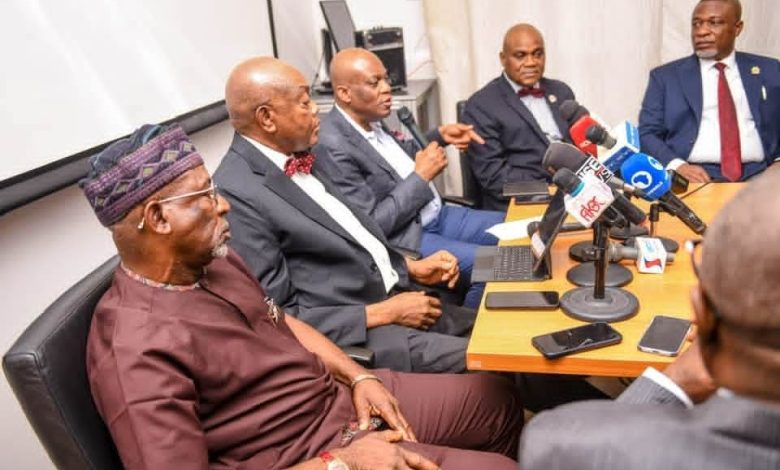
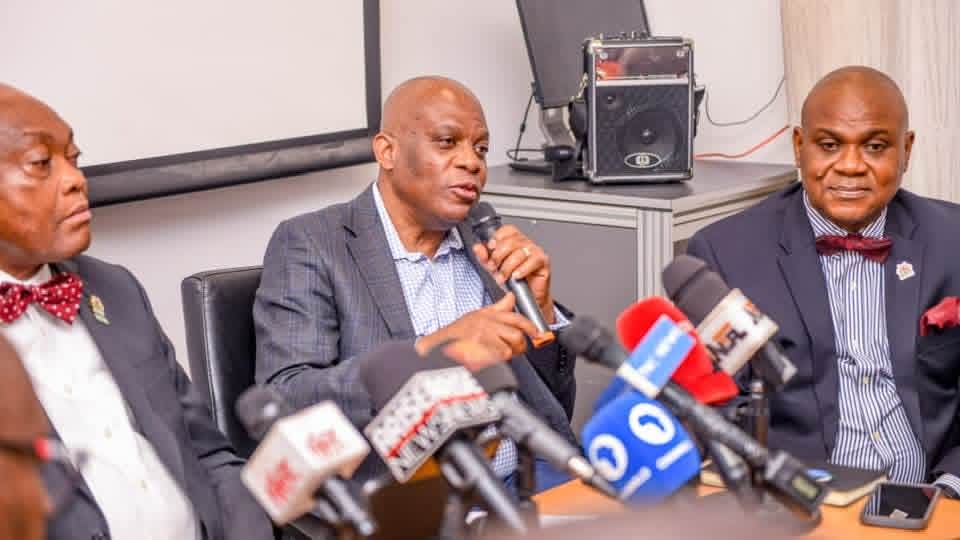
Speaking during a press briefing at Government House, Uyo, on the purported inter-agency committee report on oil wells, the state’s Attorney General and Commissioner for Justice, Uko Udom, SAN, stated that all the oil wells in question, whether existing or newly referenced, are located within the recognised maritime and coastal boundaries of Akwa Ibom State, based on established hydrographic coordinates and legally enforceable boundary adjudications.



Udom stated that this attribution followed due process and was based on empirical geographic data, noting that what RMFAC received on February 13, 2026, as it publicly clarified, was a draft report and not a decision, an approved recommendation, or a reallocation of oil wells.
Mr Udom reiterated the binding authority of the Supreme Court of Nigeria which ruled in favour of Akwa Ibom State regarding the ownership of the oil wells in question, highlighting that the apex Court’s decisions, particularly in 2005 and 2012, have firmly established Akwa Ibom’s entitlement to the resources, following the landmark International Court of Justice ruling on the land and maritime boundary between Nigeria and Cameroon.
“The Commission has described the circulating claims as speculative and not reflective of any final position. Beyond this procedural clarification lies a more fundamental issue — the binding authority of the Supreme Court of Nigeria and the settled history of this dispute”.
According to the Commissioner, Cross River State filed Suit No. 124/1999 against Akwa Ibom State concerning two main issues: the northern non-estuarine boundary, which involved 24 villages in Oku, Itu, and Ayadehe within the Itu Local Government Area of Akwa Ibom State, and the southern estuarine boundary where the oil wells are located.
He noted that the Supreme Court, on 24th June 2005, ruled in favour of Cross River State only with respect to portions of the northern boundary while it dismissed Cross River’s claim over the estuarine southern territory, where all the oil wells are situated.
Udom stated, “In its landmark pronouncement, the Court made it clear that the October 10, 2002 judgment of the International Court of Justice on the land and maritime boundary between Nigeria and Cameroon had fundamentally altered Cross River State’s coastal status.
“The Court held that the ICJ decision effectively eliminated Cross River’s estuarine sector, with the legal implication that Cross River no longer possessed a seaward boundary.
“Subsequently, despite Akwa Ibom State’s efforts to promote peaceful engagement and preserve kinship and harmony, further litigation was initiated by Cross River State seeking clarification on offshore entitlements.
“On 10th July 2012, the Supreme Court again ruled decisively in favour of Akwa Ibom State, holding that Cross River State was no longer a littoral state entitled to offshore derivation; its case was founded on a legally unsustainable assumption; and Akwa Ibom State’s entitlement to the oil wells was fully recognised.
“The legal position therefore stands firmly established: following the cession of the Bakassi Peninsula pursuant to the 2002 ICJ judgment, Cross River State ceased to have a seaward boundary and lost its status as a littoral state for purposes of offshore oil derivation”
Udom further stated that under Section 235 of the 1999 Constitution of the Federal Republic of Nigeria, the decisions of the Supreme Court are final and binding on all authorities and persons throughout the Federation, emphasising that there is no higher court, there is no supervisory committee, and there is no administrative override.
“No inter-agency committee, no technical panel, and no institutional process can alter, amend, reinterpret, or sit in appeal over a judgment of the Supreme Court. Any action inconsistent with a subsisting judgment of the apex court would be unconstitutional, null, and void”.
The Attorney General assured citizens that the Akwa Ibom State Government is vigilant and committed to defending its economic interests, stating, “Your Government is vigilant, engaged, and fully committed to protecting the economic interests of our State. We will not surrender our God-given resources”.
Joining the Attorney General during the briefing were his predecessors, Paul Usoro, SAN; and Ekpenyong Ntekim; former Special Duties Commissioner, Emmanuel Enoidem, SAN; Commissioner for Information, Mr Aniekan Umanah; Commissioner for Finance, Mr Emem Bob, the State Surveyor General and the Chief Press Secretary to the Governor, Ekerette Udoh, among others.