
The Importance of Automotive Technology, Transport, and Logistics in the Growth of Nigeria’s Economy

By Okon Okon
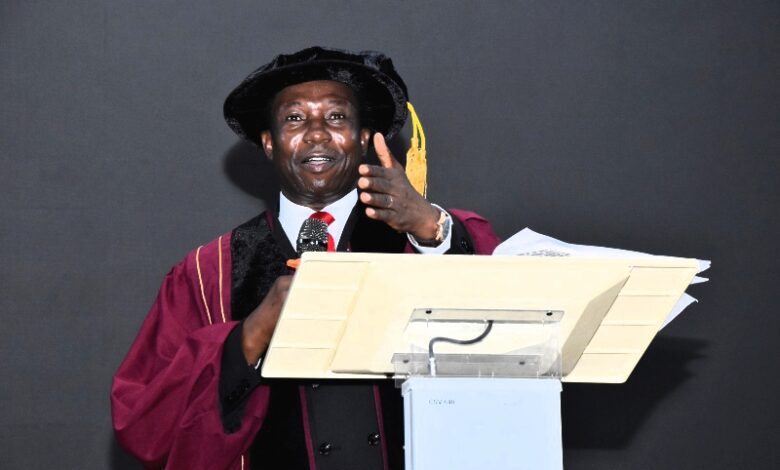
On Friday, 25th September 2026, the Executive Chairman, Akwa Ibom State Internal Revenue Service (AKIRS), Sir Okon Okon, FCTI, delivered what many described as a masterpiece Keynote Address on the theme: “The Role of Automotive Technology, Transport and Logistics in the Economic Growth of Nigeria” at the Akwa Ibom State University (AKSU), Ikot Akpaden, Mkpatenin Local Government Area. It was part of the programme marking the graduation ceremony of the second batch of graduands of the Centre for Automotive Training, Transport and Logistics (CATTL) of the institution.
Anchoring his thesis on the timeless postulations of Joseph Schumpeter (1883-1950), an influential Austrian-American economist of the 20th century and progenitor of the concept of “Creative Destruction”, Sir Okon, with epistemic sagacity and humility, explored and located the nexus between innovation, technology and entrepreneurship in economic growth and nation building.
Okon, a Fellow and Council Member of the Chartered Institute of Taxation of Nigeria (CITN); Member, Presidential Committee on Fiscal Policy and Tax Reforms, is an Economist, Resource Management Expert, and Investment Banker with over 37 years of cognate experience across private and public finance sectors.




On popular demand, Ibom Nation Newspaper hereby presents the inspiring contents of the keynote address in the interest of scholars, policy experts, and the general public.
The Importance of Automotive Technology, Transport, and Logistics in the Growth of Nigeria’s Economy
Preamble
It is a privilege to stand before you today at this prestigious center of learning and technical innovation. Graduation ceremonies are always moments of celebration, but today is particularly special because we are honouring a group of young men and women who have chosen to master the physical engines of our economy. I thank my friend and the VC, Prof. OttoAbasi Akpan, and my brother the Director of the Centre, Engr. Dr. Godwin Ekong, Associate Professor of Mechanical Engineering, and the entire management of the University for the privilege to address this August occasion.
Permit me to specially acknowledge our visionary leader and Governor, His Excellency, Pastor Umo Eno, Ph.D., the visitor of the University, whose A.R.I.S.E. Agenda continues to revolutionize the human capital landscape within our State and by extension our nation. By pioneering technology-driven youth initiatives, His Excellency has created the fertile ground upon which institutions and programmes like CATTL flourish, ensuring our graduates step into an enabling environment built for our subnational and national economic advancement. We are proud of you, Your Excellency!
May I also profoundly commend the leadership of Akwa Ibom State University (AKSU) and the Centre for Automotive Training, Transport & Logistics (CATTL) for their unwavering commitment to practical education. By applying sound engineering principles to train a workforce that powers sectors like Agriculture, Health, Manufacturing, Oil & Gas, Aviation, and Public Transport, CATTL is actively shaping the very future of human capital and economic growth in Nigeria. I salute you!
To this graduating batch, today is a celebration of your discipline, grit, and mastery over the physical engines that power our society. We are here to honour your achievement and to affirm the vital role you are about to play in driving the future of our state and nation. Congratulations!
The Context
To appreciate why we are gathered here today, we must look at our world through the clear lens of commerce and economics. When we strip away the complex jargons, every economy in the world rests on a few basic questions such as; What to produce? How to produce? At what cost? Whom to produce for? How to get the products to the marketplace (to the final consumers)? At what price?
Money, finance, and revenue are crucial, but they are the outcome of true economic values which are created when physical or mental resources are transformed into useful products and delivered efficiently to markets (final consumers).
This brings us to a fundamental economic insight pioneered way back in the 20th century by a great global economist with Austrian origin, Joseph Schumpeter (1883 – 1950). Schumpeter taught us that real economic growth does not come merely from doing the same things over and over; it comes from innovation, what he famously termed “Creative Destruction”, which at its core refers to a new or improved technology replacing an obsolete or old one, and driven by entrepreneurs. Growth happens when entrepreneurs including engineers, mechanics and technicians introduce new technologies, streamline processes, and create faster, smarter ways of doing things and displacing old or inefficient methods.
It is important to note that while there are no alternatives to transportation & logistics as aids to commerce, they are however, susceptible to technological disruptions and advancements essential for economic growth.
In the light of current economic realities in Nigeria which is marked by structural economic reforms, shifting energy source and cost, and the urgent but age long demand for domestic self-reliance, Schumpeter’s postulation, as old as it is, becomes our practical reality.
The above therefore fine-tunes the context of our theme to: Driving sustainable economic growth via innovations in automotive mechanisms, transport and logistics assets which are enablers for distribution, efficiency and safe speed to market.
2 .The Interconnection of Automotive Technology, Transport, and Logistics
Building on this economic context, let us take a deep dive into the theme of today’s event: The Importance of Automotive Technology, Transport, and Logistics In The Growth of Nigeria’s Economy. Automotive technology, transport networks, and logistics systems are not three isolated fields, they are three links in a single, continuous economic chain.
Automotive Technology is the foundation. It is no longer just about spanners and grease; it is the high-tech fusion of mechanical engineering, micro-electronics, and computerized diagnostics that keeps a vehicle safe, efficient, and operational for transportation, be it big or small, private or commercial.
Transport Networks are the channels and economic bridges. They serve as the physical connectors, bridging rural production hubs with urban markets, factories with target markets, thereby driving both domestic and cross-border trade.
Logistics Systems are the brains. They provide warehousing, route planning, inventory timing, and optimized supply-chain management to ensure that goods arrive at the right place, at the right time, at minimal cost. When these three components function in harmony, commerce moves with speed and predictability. When any link breaks, economic activity risks a halt.
3 .How Automotive Technology, Transport, and Logistics Drive Economic Growth in Nigeria
From a public finance and macroeconomic perspective, your profession directly strengthens Nigeria’s economy in the following practical ways among others:
Inflation Control : Advanced automotive diagnostics reduce vehicular breakdowns and optimize fuel efficiency. Lower transport overheads mean lower prices for everyday goods in our local markets.
(ii) Food Security & Producers’ Risk Mitigation: Precision logistics and efficient transport network significantly reduce post-harvest losses by ensuring timely movement of agricultural produce from rural to urban markets, thereby preserving rural farmer wealth and securing urban food supplies.
Speed to Market & Preservation : Streamlined transport networks and purpose-built logistics accelerate time-to-market while preserving product freshness, enabling enterprises to capture peak commercial value before spoilage or shelf-life decay occurs.
Ease of Doing Business: Predictable transit corridors and tech-driven logistics remove or minimizes distribution barriers, trade friction and non-state actors’ interferences, thus promoting seamless commerce.
Job Creation & Entrepreneurship : The technical capacity and expertise you have acquired are capable of fueling job creation by transforming skilled trainees into self-reliant entrepreneurs who establish diagnostic hubs, fleet maintenance workshops, and supply-chain enterprises that have the capacity to employ many youths across our communities and cities.
Cost Minimization: Precision diagnostic maintenance and optimized fleet routing eliminate systemic operational waste, directly lowering transaction overheads and boosting profitability for commercial enterprises.
Domestic and Regional Trade: Modern and efficient transport system unlocks seamless domestic and cross-border trade thereby positioning Akwa Ibom State and Nigeria as a strategic commercial hub.
Sustainable Public Revenue: Formalized, efficient transport and logistics sectors generate stable, accountable tax revenue opportunities that enables the government to reinvest in economic infrastructure, healthcare, public education, social amenities, and other public goods.
Minimized Road Accident Risks: Rigorous automotive diagnostic standards and standardized transport protocols significantly reduce road accidents, safeguarding human lives, preventing cargo loss, and protecting valuable corporate assets and public revenue from destruction.
(4) Challenges Confronting the Automotive Technology, Transport, and Logistics Sector in Nigeria
While the potential of this sector is immense, we must candidly acknowledge the challenges facing it today, namely:
Scarcity of genuine parts due to dependency on imports which itself is affected by high exchange rate and tariffs.
(ii)High operational costs driven by hyper-rising energy price and skyrocketing maintenance costs.
(iii) Infrastructure deficit which slows down turnaround time, increases vehicular wear and tear, and diminishes returns on investment.
(iv)Persistent reliance on trial-and-error maintenance approach rather than precision computerized diagnostics.
(v) The rapid pace of technological change from traditional internal combustion engines to hybrid systems, Compressed Natural Gas (CNG), and Electric Vehicles (EVs), risks leaving behind technicians who cannot update their skills accordingly.
5.Alignment with CATTL, AKSU’s Objectives
This brings us to the corporate values of your alma mater. CATTL’s vision was crafted to solve these exact national challenges by providing Scientific Training, Diagnostic Mastery, and Structured Technical Capacity. The training you received here aligns directly with core state and national priorities:
*Local Component Innovation* : Learning to adapt and design machinery components using local materials to foster industrial self-reliance.
Diagnostic Precision: Moving away from guesswork or trial-and-error in vehicle maintenance to accurate, software-driven diagnostics that guarantees value to clients.
Supervisory Leadership: Developing the technical discipline needed to lead complex maintenance teams, fleet operations, and logistics corridors across Nigeria’s key industries, from Agriculture and Oil & Gas to Healthcare, Manufacturing, and Mass Transportation.
Standard Logistics: Building standardized, adaptable supply-chain protocols equips technicians and transport officers to seamlessly power both high-capacity industrial enterprises as well as high-scale and quasi-commerce that fuels daily trade across Nigeria.
(6) Economic Opportunities for the Graduands
As you step out today, you are entering a market that urgently requires your specific technical expertise. In the light of the current national economic realities, marked by increased demand for improvement in transportation, logistics, ease of doing business, push for food security, transition toward energy efficiency, local content development, supply-chain optimization, globalization, etc., several immediate economic windows, including the following are open to you:
(I)Market Size: Based on 2023 statistics from National Bureau of Statistics (NBS) and Federal Road Safety Commission (FRSC) on national vehicle population, the current number of registered vehicles nationwide can be estimated at about 14 million, implying that the market size for your services is huge.
(ii)Upgrading, Standardization & Automation of Automobile Maintenance: Modern vehicles rely heavily on Electronic Control Units (ECUs) and sensor technology. This creates a huge and real opportunity to modernize traditional workshops through standardized repair protocols, digital diagnostic software, and automated service tools which transforms manual garages into high-yield, structured enterprise centers, thereby eliminating informal, unstructured, trial-and-error systems.
(iii)Corporate Fleet Management & Industrial Operations: Major players across the Oil & Gas, Healthcare, Aviation, Manufacturing, and Public Transit sectors require disciplined supervisory personnel to oversee vehicle health, optimize routing, and lower operational overheads.
(iv)Alternative Energy & Conversion Technologies: With rising conventional fuel costs, there is a growing demand for Compressed Natural Gas (CNG) conversions, hybrid vehicle servicing, and fleet fuel-efficiency diagnostics across Nigeria.
(v)Agro-Logistics, FMCG, & Cold-Chain Management: As Akwa Ibom State and Nigeria prioritize agricultural production, skilled logistics operators and transport officers are needed to manage fleet operations, reduce post-harvest losses, and connect rural farming hubs to commercial centers. Same for Fast Moving Consumer Goods (FMCG) inventory chain management.
(vi)Supply Chain & E-Commerce Logistics: The rapid expansion of digital commerce across urban and semi-urban centers creates endless opportunities for micro-logistics agencies, last-mile delivery services, and supply-chain management as the digital commerce dovetails into physical logistics.
(vii) Transfer of Skills & Human Capital Development: Institutionalizing practical knowledge transfer ensures that advanced diagnostic expertise and structured logistics skills are continuously passed down to generations in order to build a sustainable pool of highly skilled, self-reliant technical workforce for national development. Your skills place you at the center of these expanding markets, making you key economic actors capable of generating immediate value, building sustainable businesses, and creating wealth.
7 Message to the Graduands and Stakeholders : As we look to the future, I offer three brief charges:
(I)To AKSU and CATTL Management: Continue to deepen your research, expand your industry partnerships, and refine your curriculum to continuously align with global technological shifts and best practices so that this institution remains a national benchmark.
(ii) To Industry Leaders and Investors: Look no further beyond these graduates. Invest in their talents, absorb them into your fleet maintenance, transportation, and supply chains, and watch your operational efficiency thrive.
(iii) To our Graduating Class: What you have acquired here is more than technical and trade skills; it is a call to Stewardship and Service. Always remember that success will require three non-negotiable pillars:
Integrity & Excellence in your work.
Continuous Learning as technology evolves.
Mentorship to lift others as you grow.
Go out there with confidence, courage, and pride. You are not job seekers; you are job creators, entrepreneurs, innovators, and problem solvers powering the nation’s economic engine.
Conclusion
On behalf of my family and the Akwa Ibom State Internal Revenue Service, I congratulate every graduating trainee of the Second Batch of this great center.
May your hands remain skilled, may your diagnostics be accurate, may your work bring wealth and honour to your families, and may your contributions propel Akwa Ibom State and Nigeria toward sustainable economic prosperity. But, when you make your money, remember to pay your taxes for the public good!