

By Mercy Ikpa & Ekaette George
A civil society organisation, Ibom Peoples’ Empowerment and Ecosystem Restoration Foundation (Ibom PEER Foundation), has highlighted a series of investigative toolkits aimed at shedding light on the complexities and challenges within Nigeria’s extractive sector.
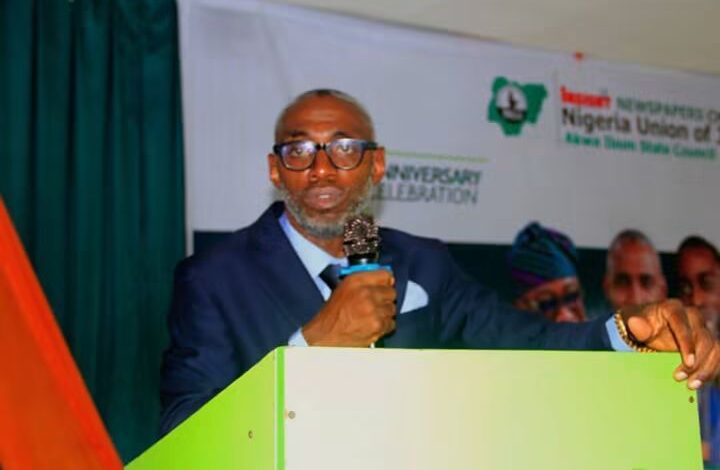
Executive Director of Ibom PEER Foundation, Mr Mfon Gabriel, made the presentation Wednesday, last week, in his Keynote address at the 13th anniversary celebration of Insight Chapel of the Nigeria Union of Journalists (NUJ), Akwa Ibom State Council, held in Uyo.
Speaking on the theme, “Media Advocacy and Investigation Across Extract Sector Value Chain in Nigeria,” Mr Gabriel listed the six stages of Nigeria’s extractive sector value chain, including Exploration, Development, Production, Trading and Export, Revenue Collection, and Revenue Allocation, emphasising that each stage presents potential points of leakage which journalists must skillfully investigate to ensure transparency and accountability.




He outlined seven investigative angles that journalists can explore to uncover potential malpractices and inefficiencies in the sector.
Among the highlighted issues was the opaque financial management of the Chevron-NNPCL Escravos Gas-to-Liquid (EGLT) project, which generated a staggering $1.124 billion in revenue for 2023.
Gabriel revealed that the revenue sits in a Special Purpose Vehicle (SPV) whose bank statements have been withheld from auditors by NNPCL, raising questions about transparency and accountability.
Another alarming angle presented was the existence of 2,700 “ghost wells” of the Niger Delta, where shut-in strings outnumber the 2,344 producing ones concentrated among NEPL, Shell Petroleum Development Company of Nigeria Limited (SPDC), Mobil, Chevron, Heirs, and Aiteo.
He said, “Investigate whether operators are deliberately deferring production to dodge environment remediation liabilities, or simply hoarding book reserves without investing in output – and cross reference against NUPRC’s cost-benchmarking data, which shows deep-offshore wells running up to US$52 million apiece, to ask whether operators are over-invoicing new drilling while leaving thousands of existing strings idle”.
Mr Gabriel also touched on the stalled negotiations surrounding the OPL 245 settlement with ENI/Agip, which has been hindered by undisclosed “outstanding issues,” urging journalists to investigate the fiscal terms involved.
The presentation also highlighted the mysterious disappearance of $7.61 million from OML 116 before the Federation transfer, alongside $162.9 million in cash calls that were paid twice for assets already transferred to NPDC.
Gabriel did not stop at the oil and gas sector; he also addressed the burgeoning lithium rush, where $800 million in Chinese investment “sits atop a ‘devastated landscape’, documented child labour, and $9bn/yr in illegal mining losses”
He pointed out the regulatory vacuum in the steel sector following the rejection of the Metallurgical Industry Bill, urging journalists to investigate the lobbying efforts behind this outcome.
In a call to action, Gabriel introduced a field-ready toolkit for journalists, which includes strategies such as Freedom of Information Act (FOIA) requisitions to obtain Community Development Agreements, cross-referencing MCO and CAC databases to identify beneficial owners, and leveraging legal recourse to address mining disputes.
The presentation also provided key insights into Nigeria’s extractive sector, revealing that oil and gas account for 65% of government revenue and 85% of exports, while solid minerals remain largely untapped despite being valued at over $700 billion.
Gabriel said the exploration crisis, exacerbated by insecurity, has led to the abandonment of gold sites in the Northern part of Nigeria, further complicating the landscape.
He emphasised the importance of understanding the value chain to identify where money is lost and the need for a remediation roadmap to recover such funds.
Earlier in his welcome address, a former member of the Akwa Ibom State House of Assembly, Rt. Hon. (Dr.) Usoro Akpanusoh, urged journalists to strengthen their advocacy and investigative efforts to promote transparency, accountability, and sustainable practices in Nigeria’s extractive sector.
Akpanusoh, who was the Chairman of the Session, explained that his experience as a lawmaker from an oil-bearing constituency had given him firsthand insight into the complexities and challenges confronting communities affected by extractive activities.
He urged journalists to expose practices that threaten the environment and the wellbeing of communities, while advocating for policies and practices that promote environmental sustainability and protect future generations.
Earlier, in his opening address, the Chairman of Insight Chapel, Comrade Itoro Bassey, said the 13th anniversary was an opportunity to reflect on the contributions of the Chapel and the media to society.
Bassey described Weekly Insight as one of the oldest regional newspapers based in Akwa Ibom State, noting that the publication has remained committed to being “the voice of the voiceless” and advancing the journalism profession.
In his remarks, the State Chairman of the NUJ, Akwa Ibom State Council, Comrade Nsibiet John, commended the leadership of Insight Newspapers Chapel for “raising the bar” in journalism and leadership through the programme, assuring that the Union would continue to support its various chapels and members towards professional growth and development.